


 Runbase Team
TL;DR: The best fal.ai alternatives in 2026 are Runbase, Replicate, Together AI, Hugging Face, Stability AI, Baseten, and RunPod. If you want the same image and video models (GPT Image, Nano Banana, Veo, Kling, Hailuo) for less money, Runbase runs them for up to 77% less than fal.ai and refunds failed generations. If you need fal.ai's 600+ model catalog or its sub-second latency, stay on fal.ai. Runbase is adding new models all the time — if one you need isn't live yet, just email us.
fal.ai vs Runbase: real pricing
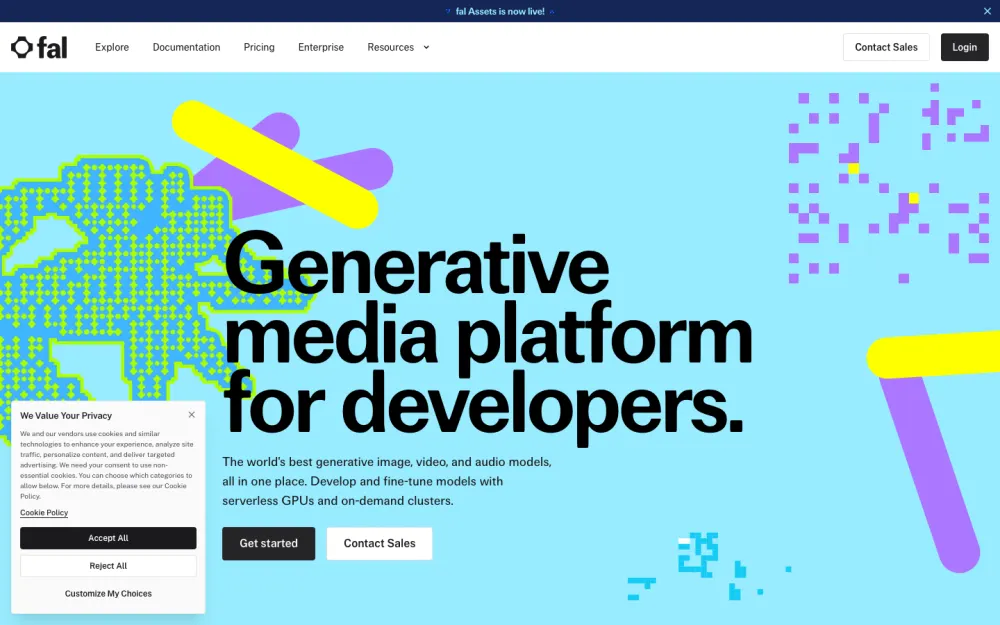
fal.ai bills per output, and for premium models that gets expensive fast — Runbase runs the same models for up to 77% less. fal.ai is a genuinely strong product (600+ models, low latency, used in production by Adobe, Canva, and Shopify), so this isn't about fal.ai being bad — it's about paying less for the exact same models. Here is the same model on each platform (fal.ai prices checked June 2026):
| Model | Type | Unit | Runbase | fal.ai | You save |
|---|---|---|---|---|---|
| GPT Image 2 | Image | per image (1K) | $0.05 | $0.22 | 77% |
| Nano Banana Pro | Image | per image (1K) | $0.06 | $0.15 | 60% |
| Nano Banana 2 | Image | per image (1K) | $0.04 | $0.08 | 50% |
| Nano Banana | Image | per image | $0.025 | $0.039 | 36% |
| Veo 3.1 Fast | Video | per clip (720p) | $0.33 | $1.20 | 73% |
| Hailuo Pro | Video | per clip | $0.31 | $0.49 | 37% |
At volume the gap compounds — and Runbase auto-refunds failed generations, while fal.ai (like most per-output APIs) bills you even when a generation fails:
| Monthly volume on the same model | fal.ai | Runbase | You save |
|---|---|---|---|
| 10,000 GPT Image 2 (1K) | $2,200 | $500 | $1,700 |
| 50,000 Nano Banana | $1,950 | $1,250 | $700 |
| 5,000 Veo 3.1 Fast clips | $6,000 | $1,650 | $4,350 |
fal.ai alternatives at a glance
| Platform | Best for | Model focus | Billing | Free start |
|---|---|---|---|---|
| Runbase | Same top models, far lower price | Curated image & video (GPT Image, Nano Banana, Veo, Kling, Hailuo, Seedream) | Credit wallet, per output, failures refunded | ✅ No credit card |
| Replicate | Model breadth & community models | 50,000+ Cog models, LLM + media | Per-second compute | ❌ |
| Together AI | Open-source & LLM-heavy stacks | LLMs, image, vision (OpenAI-compatible) | Per-token / per-GPU-hour | ✅ $25 credits |
| Hugging Face | Open-model experimentation | Open model hub + Inference Providers | Per-request / per-hour | ✅ Limited |
| Stability AI | First-party Stable Diffusion/Video | Stable Diffusion, Stable Video | Credit-based | ✅ Trial |
| Baseten | Deploying your own models | Custom model serving | Per-GPU-minute | ✅ Credits |
| RunPod | Cheapest raw GPU | Bring-your-own model | Per-second GPU | ❌ |
The 7 best fal.ai alternatives in 2026
1. Runbase — the same top models for up to 77% less
Runbase runs the same top image and video models as fal.ai — GPT Image, Nano Banana, Seedream, Kling, Hailuo, and Veo — for a fraction of the price, through one REST endpoint and one credit wallet. It doesn't host 600+ models or rent GPU clusters; it curates the models most products actually ship with, prices them lower (see the tables above), and refunds anything that fails.
Where Runbase wins:
- Up to 77% lower per-output cost than fal.ai on the same mainstream models.
- Pay only for success — failed generations are auto-refunded, not billed.
- One API, every model — single key, unified billing, no per-provider accounts. Switch models by changing one
modelstring. - No SDK to install — one REST endpoint, and no credit card to start.
- Playground + per-model docs with copy-paste code samples.
Where fal.ai beats Runbase: fal.ai's speed-tuned engine has lower raw latency; Runbase optimizes for cost and stability, so it can run slightly slower (the gap is small and shrinking). fal.ai also has a far larger catalog (600+ vs Runbase's curated set) and offers custom LoRA deployment and enterprise compliance (SOC 2, SSO) that Runbase does not yet.
Best for: cost-sensitive teams generating at volume — batch pipelines, async jobs, content backfills — where price and reliability matter more than shaving a few hundred milliseconds. Not for: real-time interactive UIs where latency is visible to the end user.
2. Replicate — the breadth champion
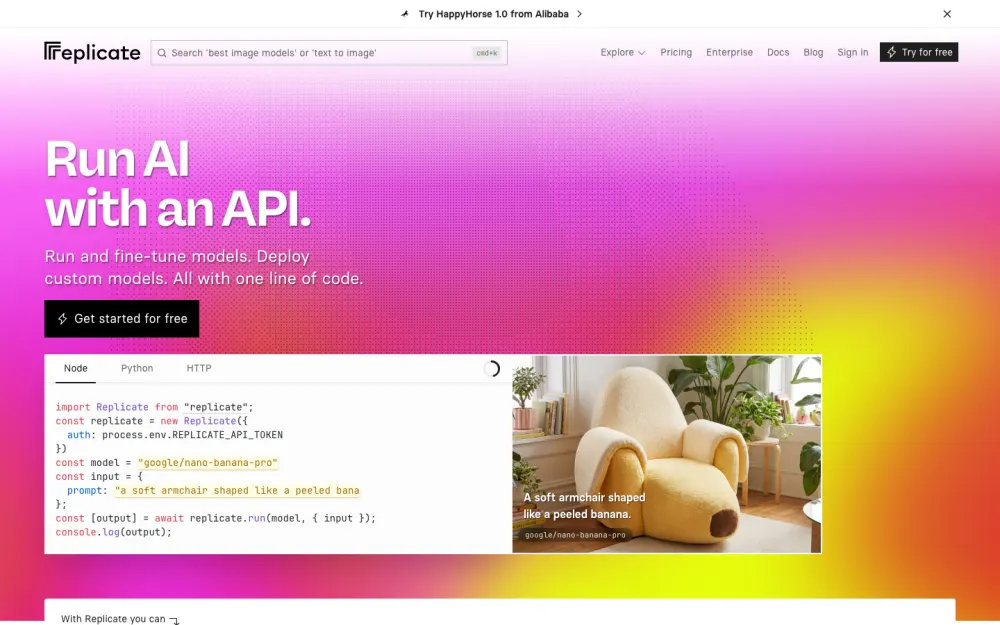
Replicate is the fal.ai alternative to pick when model variety matters most. Its 50,000+ community-published Cog models cover everything from mainstream diffusion to obscure research releases, plus LLMs alongside media.
- Billing: per-second of compute, by hardware selected.
- Strengths: the largest open ecosystem, excellent docs, easy to find niche models, LLM + media on one platform.
- Trade-offs: pricier and slower than fal.ai on mainstream image/video models, no free tier, and per-second billing is less predictable than per-output.
- Best for: teams that rely on niche or community models, or want LLM + media under one roof.
3. Together AI — open-source and OpenAI-compatible
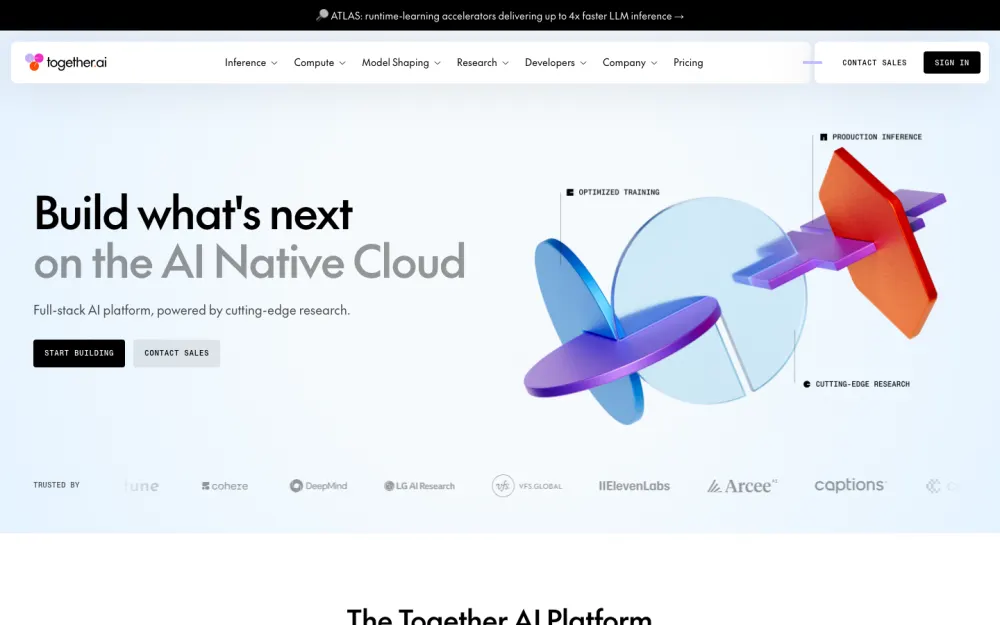
Together AI is the best fal.ai alternative for open-source, LLM-heavy stacks. It's a full-stack inference and training platform whose OpenAI-compatible API makes it a near drop-in for teams already on the OpenAI SDK, and it also serves image and vision models.
- Billing: per-token for serverless, per-GPU-hour for dedicated; $25 in free credits for new accounts.
- Strengths: open-source first, fine-tuning, batch discounts, dedicated GPUs.
- Trade-offs: media generation is secondary to its LLM focus; not where you'll find the latest video models.
- Best for: open-source-first stacks that want chat + image on one OpenAI-shaped API.
4. Hugging Face — the open-model playground
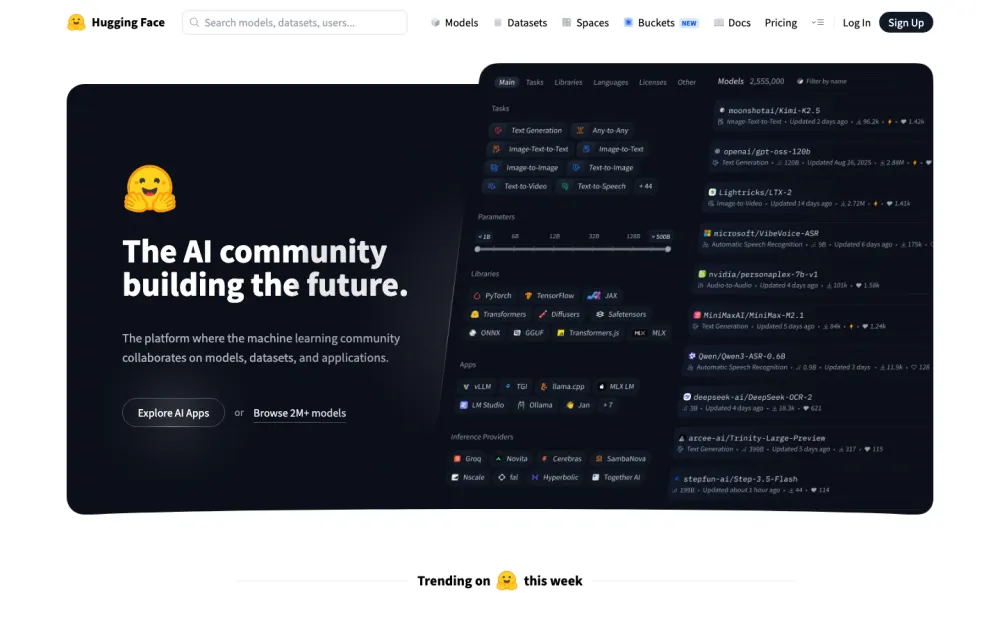
Hugging Face is the fal.ai alternative for experimenting across the widest range of open models. Its Inference Providers and Endpoints sit on top of the largest open-model hub on the internet — the natural home for teams living in the Transformers/Diffusers ecosystem.
- Strengths: unmatched open-model selection, strong community, easy prototyping, flexible deployment.
- Trade-offs: performance and cost vary by provider and model; less of a turnkey production media pipeline than fal.ai or Runbase.
- Best for: researchers and developers experimenting across many open models.
5. Stability AI — first-party image and video
Stability AI is the fal.ai alternative if you specifically want Stable Diffusion–family and Stable Video models from the source. You get the latest SD releases first-party, with credit-based pricing and a trial.
- Strengths: authoritative source for SD models, consistent quality, straightforward image/video API.
- Trade-offs: narrower than a multi-model aggregator — you commit to one model family instead of picking the best model per task.
- Best for: products built specifically around Stable Diffusion / Stable Video.
6. Baseten — deploy your own models
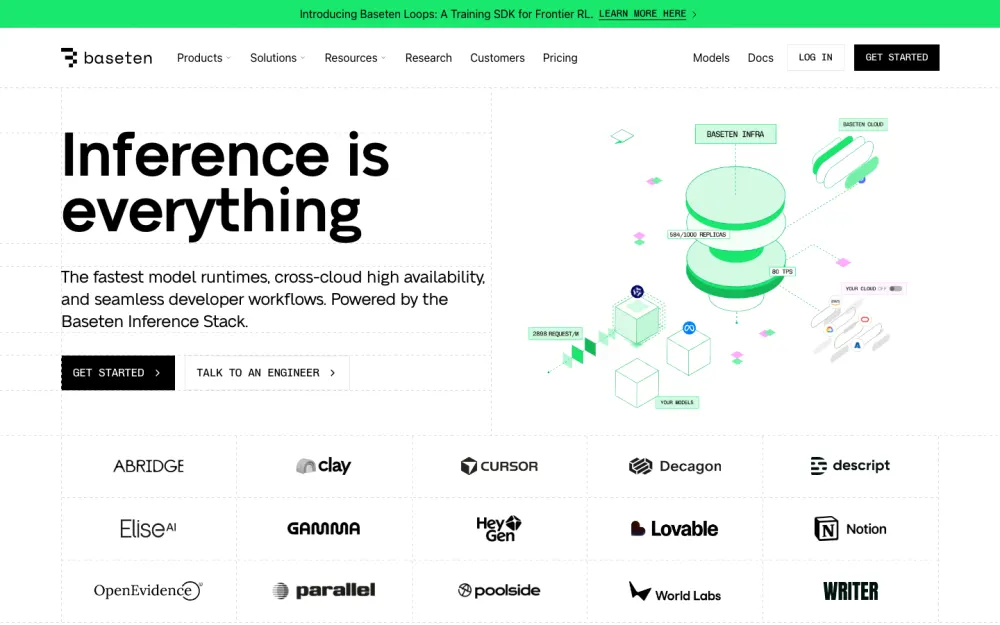
Baseten is the fal.ai alternative for teams that want to serve their own models with production-grade infrastructure: autoscaling, observability, and fast cold starts on dedicated GPUs.
- Billing: per-GPU-minute.
- Strengths: full control over custom and fine-tuned models, strong tooling, scales cleanly.
- Trade-offs: you bring the model and own more of the MLOps; not a plug-and-play media catalog.
- Best for: teams running proprietary or heavily fine-tuned models in production.
7. RunPod — the cheapest raw GPU
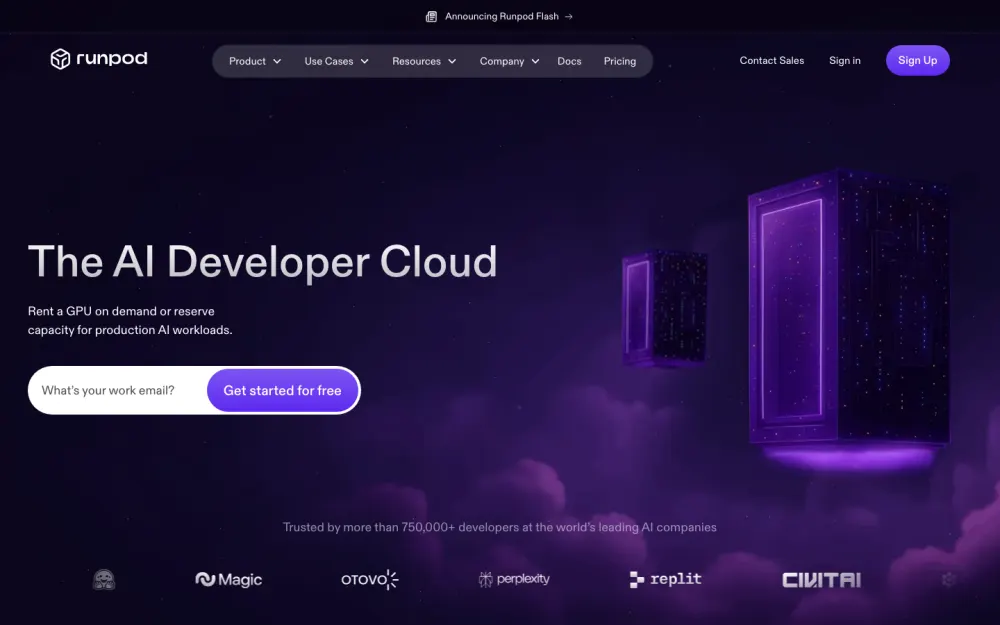
RunPod is the fal.ai alternative for teams that want the cheapest raw GPU and will run their own inference stack. It offers serverless and on-demand GPUs at aggressive prices.
- Billing: per-second GPU usage.
- Strengths: low GPU prices, flexible bring-your-own-model, good for cost-sensitive custom workloads.
- Trade-offs: you manage everything — no curated catalog, no per-output pricing, more setup.
- Best for: cost-driven teams that want cheap GPUs and run their own pipeline.
How to migrate from fal.ai to Runbase
Migrating from fal.ai to Runbase is usually a one-file change: drop the SDK, POST to one REST endpoint, and poll for the result. Failed runs are refunded automatically, so you don't need extra retry-billing logic.
Before — fal.ai (Python SDK):
import fal_client

result = fal_client.subscribe(
    "fal-ai/flux-pro",
    arguments={"prompt": "a serene mountain lake at dawn"},
)
print(result["images"][0]["url"])
After — Runbase (plain REST, no SDK):
import os, time, requests

KEY = os.environ["RUNBASE_API_KEY"]
HEADERS = {"Authorization": f"Bearer {KEY}"}

# 1. Create the run
run = requests.post(
    "https://runbase.net/api/v1/runs",
    headers=HEADERS,
    json={
        "model": "openai/gpt-image-2",
        "input": {
            "prompt": "a serene mountain lake at dawn",
            "aspect_ratio": "1:1",
            "resolution": "1K",
        },
    },
).json()

# 2. Poll until done (status: pending → processing → succeeded / failed)
run_id = run["id"]
while run["status"] in ("pending", "processing"):
    time.sleep(2)
    run = requests.get(
        f"https://runbase.net/api/v1/runs/{run_id}",
        headers=HEADERS,
    ).json()

# 3. Use the output (failed runs are auto-refunded — no charge)
print(run["output"])
To switch models on Runbase, change the model string — google/veo-3, hailuo/hailuo-pro, and the rest of the catalog use the same shape. Each model has its own API reference with copy-paste code samples.
Which fal.ai alternative should you choose?
- Same top models for far less money, generating at volume → Runbase.
- Niche or community models, or LLM + media together → Replicate.
- Open-source-first and LLM-heavy on an OpenAI-shaped API → Together AI.
- Experimenting across many open models → Hugging Face.
- Building specifically on Stable Diffusion/Video → Stability AI.
- Serving your own fine-tuned models → Baseten.
- Cheapest raw GPU, running your own stack → RunPod.
Who should stay on fal.ai? If you're building a real-time, interactive experience where every hundred milliseconds is visible to the end user, or you depend on a niche model or custom LoRA deployment, fal.ai's speed-tuned engine and 600+ catalog are worth the premium. For everyone else generating media at scale — where price and reliability beat raw speed — that premium is exactly what Runbase removes.
Frequently asked questions
Q: What is the best fal.ai alternative?
A: For the same image and video models at a much lower price through one API, Runbase is the closest fal.ai alternative — the same GPT Image, Nano Banana, Veo, and Kling models for up to 77% less. For maximum model breadth, Replicate. For open-source LLM-heavy stacks, Together AI.
Q: Is there a cheaper alternative to fal.ai?
A: Yes. Runbase runs the same top models for up to 77% less — for example GPT Image 2 at $0.05/image vs fal.ai's $0.22, and Veo 3.1 Fast at $0.33/clip vs $1.20 — and refunds any generation that fails, so you only pay for successful outputs. (fal.ai prices checked June 2026.)
Q: Do I pay for failed generations?
A: On fal.ai and most per-output APIs, typically yes — a failed job is still billed. On Runbase, failed runs are automatically refunded to your credit wallet, so you only pay for outputs you actually receive.
Q: Can I switch from fal.ai without rewriting my app?
A: Mostly. Runbase is a plain REST API — one POST /api/v1/runs to start a job and one GET to poll the result, using a standard Authorization: Bearer header. Migrating from fal.ai is usually swapping the endpoint and key rather than re-architecting.
Q: Is Runbase slower than fal.ai?
A: Slightly, on raw latency — fal.ai runs a speed-tuned inference engine, while Runbase prioritizes cost and stability. The gap is small and actively shrinking. For batch and async workloads it's a non-issue; for real-time interactive UIs, test both before committing.
Q: Does fal.ai have a free tier?
A: fal.ai offers a free trial/tier, though credits and terms change — check fal.ai's pricing page for current details. Runbase requires no credit card to start.
Try Runbase against your own fal.ai bill
The honest test is your own workload: take the model you call most on fal.ai, run it on Runbase, and compare the bill. Browse the Runbase model catalog, grab an API key with no credit card, and make your first call in minutes. Get started free →
Pricing reflects public list prices as of June 2026. fal.ai changes pricing frequently — verify current rates at fal.ai/pricing. Runbase is the publisher of this comparison; competitor details are sourced from public pricing and documentation and may change.